
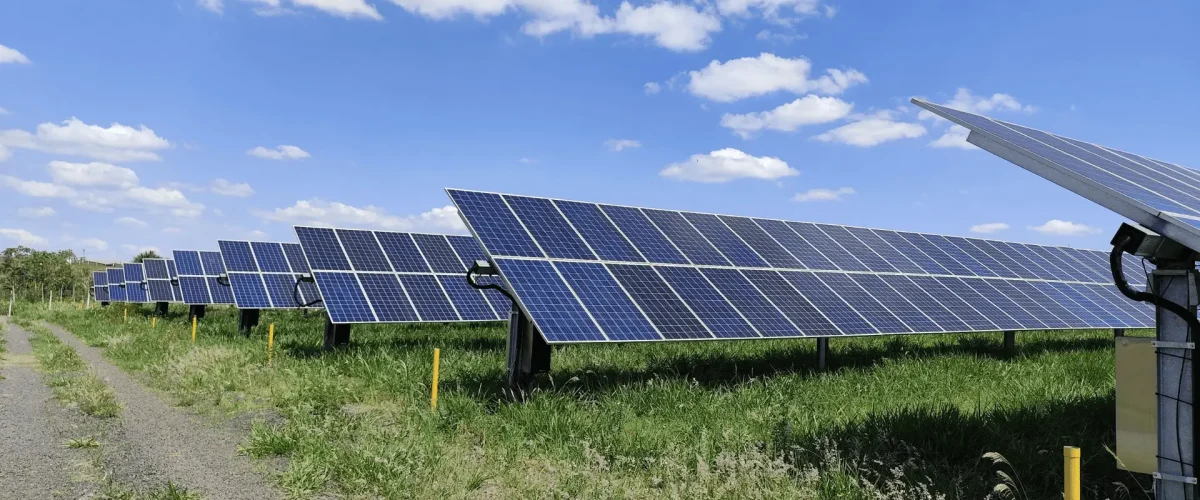
Ground-mounted solar panels are solar energy systems installed directly on the ground rather than on rooftops. They are supported by metal frames or mounting structures that hold the solar panels at an optimal angle to capture sunlight. These systems are commonly used in residential properties with large open spaces, commercial facilities, and solar farms.
Unlike rooftop installations, ground-mounted solar systems are placed in open land areas where they can receive maximum sunlight without obstruction. Because they are not limited by roof size, angle, or structural conditions, they often provide greater flexibility and efficiency in solar energy production.
Ground-mounted solar panels have become increasingly popular as more homeowners and businesses look for reliable, renewable, and cost-effective energy solutions.
How Ground-Mounted Solar Panels Work
Ground-mounted solar panels operate using the same technology as rooftop solar systems. The solar panels are made up of photovoltaic (PV) cells that convert sunlight into electricity.
When the sunlight strikes these photovoltaic cells, it produces direct current (DC) electricity. This electricity is then fed to an inverter which transforms the DC electricity into alternating current (AC) electricity. Most houses and companies rely on AC electricity in order to energize appliances, lighting, and electronic equipment.
The system can also have batteries to save the surplus energy produced in the daytime. This stored energy may be utilized in the future when the sun is not present like during the night or on rainy days.
Since the position of ground-mounted panels can be adjusted to the optimal angle and orientation, the panels typically generate more electricity than rooftop systems.
Types of Ground-Mounted Solar Panel Systems
There are two major types of ground-mounted solar systems. The types have varying advantages based on the space of installation and the energy requirements.
Standard Ground-Mounted Systems
The most common type of solar systems are the standard ground-mounted systems. In this design, the solar panels are fixed on a metal frame which is fitted in the ground with beams of steel or concrete foundations.
These systems are permanent, that is, the panels remain in a specific angle during the day. Although they are not able to move with the sun, they are able to produce large quantities of electricity from being placed with the appropriate tilt and direction.
Due to their relative simplicity, durability, and affordability, standard ground-mounted systems are very common.
Solar Tracking Systems
A more advanced form of ground-mounted installation is the solar tracking system. These systems are equipped with special mounting structures that enable the panels to track the direction of the sun across the sky throughout the day.
Solar trackers come in two types: single-axis and dual-axis trackers. Single-axis trackers are moving east-west, whereas dual-axis trackers move horizontally and vertically as well.
Tracking systems can capture a greater amount of sunlight by constantly moving the panel down the line to generate more energy. They are, however, more costly and more cumbersome to maintain than fixed systems.
Advantages of Ground-Mounted Solar Panels
Ground-mounted solar systems offer several advantages that make them attractive for many property owners.
The best positioning is one of the greatest advantages. The panels are not restricted by the roof structure; hence, they can be placed at the most optimal angle and direction to get maximum sunlight.
Increased efficiency is another benefit. Ground-mounted systems usually run at a lower temperature because of improved airflow around the panels, a factor that may enhance their performance and service life.
Ground-mounted systems have also been found to be easy to clean, inspect, and maintain. Such accessibility contributes to the system remaining functional in the long run.
Additionally, these systems allow for larger installations. Property owners with enough land can install more panels to generate greater amounts of electricity.
Limitations of Ground-Mounted Solar Systems
Although ground-mounted solar panels offer many benefits, they also have a few limitations.
Availability of land space is one of the requirements. Such systems require an appropriate open space which gets enough sunlight during the day. They may not be easy to install on properties which have limited outdoor space.
Installation also may be a bit more expensive in comparison with rooftop systems. Panels mounted on the ground require the use of other materials, like mounting structures and foundations, and wiring.
Installing in certain regions may be influenced by permits or zoning laws. Large ground-mounted solar systems might require the owners of the property to be approved.
All these notwithstanding, ground-mounted solar panels are adopted by many individuals due to their flexibility and increased power capacity.
Ground-Mounted vs Rooftop Solar Panels
Both ground-mounted and rooftop solar panels generate renewable electricity, but they differ in several ways.
Rooftop solar panels are installed on the roof of a building, making them ideal for properties with limited land space. They usually require less installation work since the roof structure supports the panels.
Ground-mounted systems, on the other hand, are installed on open land. This allows for better orientation and potentially higher energy production. They are also easier to maintain because technicians can access them without climbing onto a roof.
The choice between the two options often depends on available space, budget, and energy requirements.