
Battery Backup Calculator for Connecticut Homes
In our planning figures, one 15 kWh battery runs a refrigerator, lights, internet, and a furnace blower for a full day. Pick what you want running when the power goes out. Our home battery backup calculator sizes your battery and estimates your Connecticut incentives.
- Veteran-Owned and Women-Owned
- CT Green Bank Smart-E Contractor
- REC Certified Installer
- Certified FranklinWH Installer
- CT Lic. #HIC.0659657
How Many Batteries Does Your Home Need?
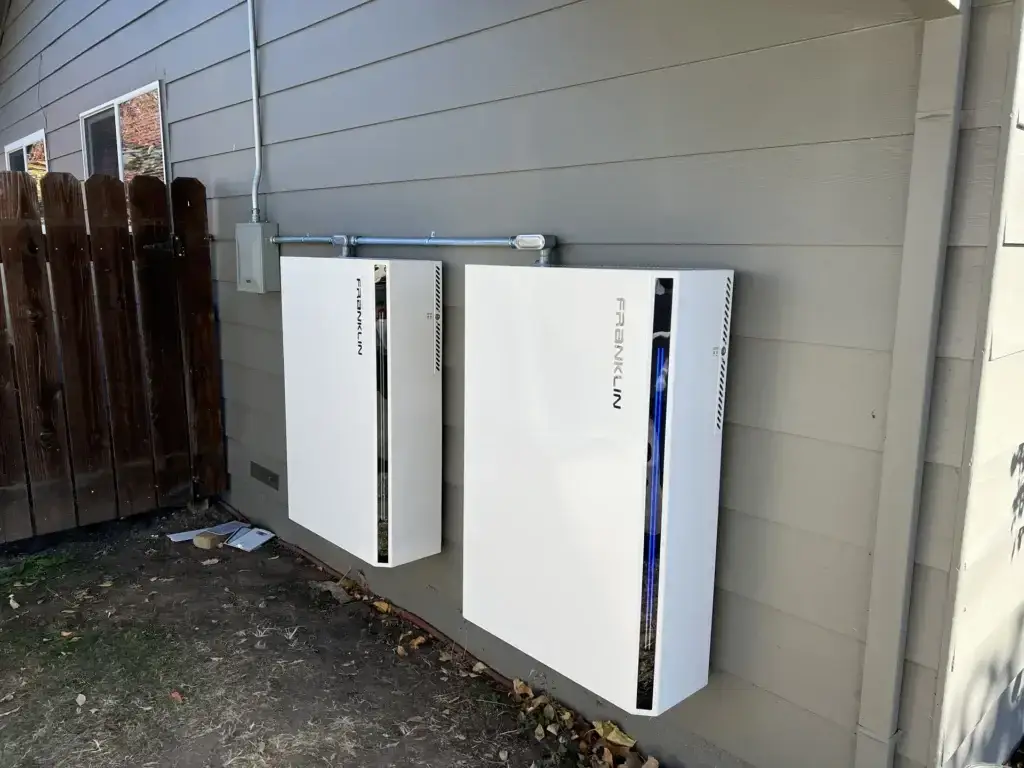
Add up what you want running in an outage and how long the outage lasts. One FranklinWH aPower 2 battery stores 15 kWh and delivers 10 kW of continuous power.
Check your items below. For the long answer, read how much battery storage you need.
Do you rely on medical equipment at home? Ask your equipment provider about backup power, and tell your utility. Do not count on this estimate for it.
Energy Storage Solutions is for Eversource and United Illuminating (UI) customers. A home on a town-owned electric utility does not qualify.
The program gives its low income rate to customers on an Eversource or UI low income discount rate. Grid edge circuits rank in the top 10 percent for the number or the length of major storm outages since July 2012. Not sure? Leave both boxes empty. We confirm your class at your visit.
This calculator gives planning estimates, not a quote or an incentive approval. Energy Storage Solutions sets the incentives. We confirm your loads, battery count, pricing, and incentive class at a free on-site visit.
How the Calculator Sizes Your Battery
The calculator follows the same steps we use on a first call.
| Step | What the calculator does |
|---|---|
| Daily energy | Multiplies each item's power draw by its run time per day, then adds the items up. |
| Outage energy | Scales daily energy to the length of your outage. With solar, each day after the first counts as half, because your panels recharge the battery. |
| Batteries for energy | Divides outage energy by 15 kWh per battery and rounds up. |
| Batteries for power | Adds the draw of every item running at once, divides by 10 kW per battery, and rounds up. |
| Your plan | Uses the larger of the two battery counts. |
The 15 kWh and 10 kW figures are FranklinWH's published specs for the aPower 2. The solar rule is our planning estimate. Snow cover and short winter days cut how much your panels recharge.
Planning Figures for Each Item
| Item | Power draw | Run time per day | Energy per day |
|---|---|---|---|
| Refrigerator | 0.2 kW | 6 hours | 1.2 kWh |
| Lights | 0.3 kW | 6 hours | 1.8 kWh |
| Internet, TV, and phone charging | 0.2 kW | 10 hours | 2 kWh |
| Furnace or boiler blower | 0.6 kW | 8 hours | 4.8 kWh |
| Well pump | 1 kW | 1.5 hours | 1.5 kWh |
| Sump pump | 0.8 kW | 2 hours | 1.6 kWh |
| Medical device | 0.2 kW | 24 hours | 4.8 kWh |
| Microwave | 1.2 kW | 0.3 hours | 0.4 kWh |
| Central air conditioning | 3.5 kW | 6 hours | 21 kWh |
| Heat pump heating | 4 kW | 8 hours | 32 kWh |
| Electric water heater | 4.5 kW | 2 hours | 9 kWh |
| Electric range or oven | 3 kW | 1 hour | 3 kWh |
| EV charging | 7.2 kW | 2 hours | 14.4 kWh |
These figures are our planning estimates, not measurements of your home. The nameplate on each appliance lists its real draw.
Connecticut Battery Incentives in the Estimate
Energy Storage Solutions offers Connecticut homeowners two incentives for an eligible home battery. The enrollment incentive lowers the price before installation, and the performance incentive pays you for 10 years.
The program is open to Eversource and UI customers. The Connecticut Green Bank, Eversource, and UI run it under the Public Utilities Regulatory Authority. The rates below apply to enrollment applications submitted on or after April 1, 2026.
| Incentive | Customer class | Rate |
|---|---|---|
| Enrollment | Standard | $30 per kWh of battery capacity |
| Enrollment | Grid edge | $130 per kWh of battery capacity |
| Performance | Standard | $300 per kW each year for 10 years |
| Performance | Underserved community | $450 per kW each year for 10 years |
| Performance | Low income | $550 per kW each year for 10 years |
The program pays the performance incentive twice a year. It counts the average kW your battery delivers during about 50 summer events and 5 winter events, not the battery's nameplate size. You choose which events to join.
What our estimate assumes
- The battery loses 2.5 percent of its capacity each year.
- Events last 2.5 hours on average.
- 62 percent of the battery's capacity counts toward each event.
- FranklinWH keeps 10 percent of the performance incentive for managing dispatch. Our estimate subtracts that fee.
The first three figures come from the program's own incentive calculator. The fee comes from the program's eligible equipment list.
Estimate for one FranklinWH aPower 2
| Customer class | Enrollment | Performance over 10 years | Total |
|---|---|---|---|
| Standard | $450 | $8,986 | $9,436 |
| Underserved community | $450 | $13,479 | $13,929 |
| Low income | $450 | $16,475 | $16,925 |
On a grid edge circuit the enrollment incentive for one battery is $1,950. These are estimates. The program sets the real amounts, and your performance payments depend on how your battery performs in events.
Underserved communities in the program's calculator
Bridgeport, Bristol, Chaplin, Derby, East Hartford, East Haven, Griswold, Groton, Hartford, Killingly, Lisbon, Mansfield, Meriden, Montville, Naugatuck, New Britain, New Haven, New London, North Stonington, Norwich, Plainfield, Plymouth, Putnam, Sprague, Sterling, Stratford, Torrington, Voluntown, Waterbury, West Haven, Willington, Winchester, Windham.
Checked November 26, 2026. The program uses the state's most recent list of distressed municipalities, so this list changes over time.
What a Home Battery Does for You
- Powers the items you choose when the grid goes down.
- Senses an outage and takes over by itself.
- Recharges from your solar panels, or from the grid if you have no solar.
- Earns performance incentives for 10 years while it takes part in program events.
- Installed by a Certified FranklinWH Installer.
Battery Backup Questions
How many batteries do I need to back up my home?
It depends on what you run and for how long. A refrigerator, lights, internet, and a furnace blower use about 10 kWh a day in our planning figures. One 15 kWh battery covers them for a full day. Large loads such as central air or EV charging add batteries.
Do I need solar panels to add a battery?
No. A battery without solar charges from the grid and powers your home in an outage. With solar, your panels recharge the battery during a long outage.
What does Connecticut pay toward a home battery?
The enrollment incentive lowers the price of your battery by $30 per kWh, or $130 per kWh on a grid edge circuit. The performance incentive pays $300 per kW each year for 10 years. That rate is $450 in underserved communities and $550 for customers on a low income discount rate.
Will the program drain my battery before a storm?
No. The program says it does not discharge batteries ahead of major storms that are predicted to cause outages. The utilities aim to cancel planned events 48 hours ahead when severe weather is expected.
How long does a home battery last?
FranklinWH backs the aPower 2 with a 15-year warranty for 60 MWh of throughput. Energy Storage Solutions requires at least a 10-year warranty on batteries and workmanship. Read how long solar batteries last.
Sources
- Energy Storage Solutions: Program Changes Effective April 1, 2026
- Energy Storage Solutions: Energy Storage for Your Home
- Energy Storage Solutions: Incentive Estimate Calculator
- Energy Storage Solutions: Eligible Equipment List
- Energy Storage Solutions: Homeowner FAQ
- FranklinWH: aPower 2
Last reviewed November 2026 by Adam H. Cooke, Premier Improvements.
Call Now or Request Your Estimate.
CT Lic. #HIC.0659657